
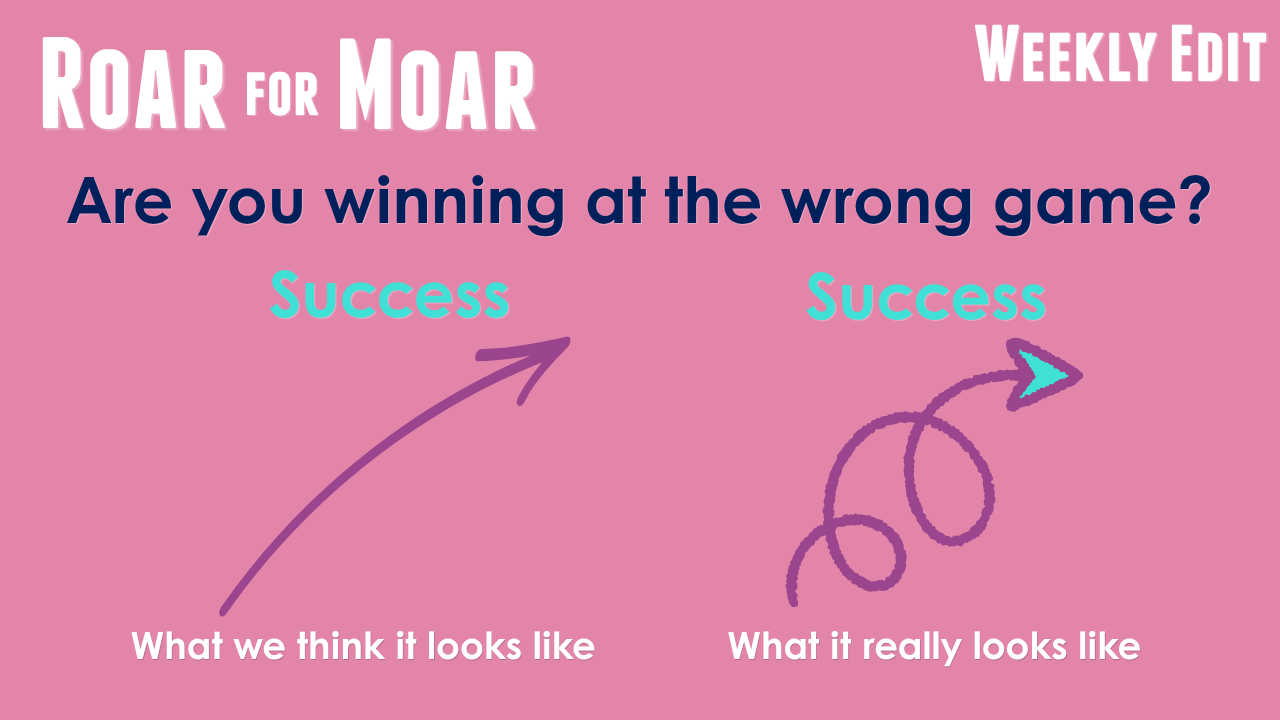
Are you winning at the wrong game?
Sep 05, 2026You’ve built something. On paper it looks flawless. The title, the track record, the respect of people whose opinion you value.
Then the laptop closes, the house goes quiet, and there it is: exhausted, uninspired, and an emptiness you’re too afraid to feel, let alone admit.
Here’s what makes it confusing. Nothing looks wrong. You’re good at this. You’re genuinely, measurably good at it.
But somewhere along the way it became performative. Doing the work for how it looks. For the approval, the title, the thing that was expected of you. And when the reason for doing it is external, so is the reward. It never reaches the part of you that’s empty.
That’s often why success makes it worse rather than better. The more you achieve, the more evidence you collect that you’re winning at something you chose for reasons that no longer match what you want.
You know something has to change, but you don’t know where to start.
How do you walk away from a game everyone thinks you’ve won, to play one where you don’t know the rules?
The day I decided to write ROAR!
In September 2017 I was on the verge of collapse: burnt out, empty and without purpose. I left a ‘successful’ corporate career after a bully brought me to my knees. I decided I would never work for someone again and founded ROAR! Coaching & Consulting. If I had known what I was letting myself in for I probably would have run for the hills.
About six months in, I came home from the gym one morning completely fired up. I decided to write my first book, to shine a spotlight on a silent epidemic called workplace bullying. I contacted the publisher I had been speaking to for weeks. I rang Heinie to tell him it was happening. I signed the publishing contract by midday.
That evening I couldn’t sleep.
Who do I think I am, writing a book? Who would possibly want to hear my story?
Somewhere in the early hours I got up and emailed the publisher to tell her I’d made a mistake.
Hours. That’s all it took. Hours between the decision and me trying to take it back in writing.
She replied the next morning, not entertaining my meltdown for one second. You’ve got this. You can do this.
ROAR! almost died before I’d written a single word.
It usually starts with enthusiasm. That lit-up feeling when you commit to something bigger than the life you’ve currently got.
Then, sometimes within minutes, comes the self-doubt. You’re about to do something you don’t know how to do yet. You start feeling anxious, and your mind, being a mind, starts telling you why you can’t do it.
Here’s what took me years to understand. The difficulty and the story about the difficulty are two different things. The difficulty is just information: this is new, you haven’t done it before. The story is what we build on top of it, and the story decides whether we carry on.
Carol Dweck spent decades on exactly this. Two people hit the same wall. One reads it as proof of their limits. The other reads it as the shape of the learning.
When the doubt arrives, I run the four-step ROAR process. Recognise the feeling of anxiety, and your thoughts: this is too hard. Observe the old story underneath it: I am not good enough. Assert the truer story: I trust in my ability to figure things out. Redirect into taking the next best step with what you have.
What I wish I had known from the start
I was winning at a game that left me empty, so I changed games. I started playing one where I didn’t know the rules, and I was petrified to be seen starting small.
I know I chose the right game, but winning is another ballgame altogether. I am still learning the rules.
We picture success as a straight line, because what we see of other people is the finished product. Effort in one end, results out the other.
Draw the real thing and it loops. Round, back on itself, round again, and then somehow, eventually, the same place.
Why do we still measure and judge ourselves as if it should be a straight line? Every detour reads as failure. Every setback becomes evidence you got it wrong. On top of the problem in front of you, you carry the shame of being someone whose plan didn’t work. That’s what burns us out.
Since leaving corporate, I started the business, moved countries, made Jamestown home. Pivot after pivot after pivot. And the journey continues.
Those pivots are what playing the right game looks like while you are still figuring out the rules.
So I built the steps I didn’t have. I created the ROAR for MOAR Hero’s Journey to help me navigate change, big or small. It’s the culmination of years of learning to figure it out, one day at a time, and it’s the spine of MOAR!
Five stages: Map your adventure, Open your life force, Act with heart, Rise through the fire, ROAR for MOAR. The first letter of each one spells MOAR. I designed them, and the twelve steps within them (see MOAR! for more), in the hope that they will smooth the way, even just a little, and help you recognise where you are on your own journey and what each stage requires of you.
They highlight one thing above all: you are not alone. We all face the same obstacles. It’s called life.
How do you know you’re in the right game?
Ask yourself: would I still want to do it if nobody was watching? If I didn’t get paid to do it? Does it ignite the fire in my belly?
Winning, it turns out, is showing up again the day after it did not work, before you have a shred of evidence that you are on the right road. Failing, and failing forwards, over and over and over again.
Theodore Roosevelt, at the Sorbonne in Paris, 23 April 1910:
It is not the critic who counts; not the man who points out how the strong man stumbles, or where the doer of deeds could have done them better. The credit belongs to the man who is actually in the arena, whose face is marred by dust and sweat and blood; who strives valiantly [. . .] who at the best knows in the end the triumph of high achievement, and who at the worst, if he fails, at least fails while daring greatly.
He said nothing about arriving in a straight line.
There is no straight line. There is just the arena, and whether you are still standing in it.
About ROAR! and MOAR!
In ROAR! How to Tame the Bully Inside and Out (December 2019), I tackle the silent damage bullying causes, in the workplace, online, and in everyday life. The book helps readers recognise toxic behaviour, understand the dynamics between bully, victim and culture, and respond with confidence and clarity rather than fear or avoidance. I wrote it after discovering, the hard way, just how common and costly workplace bullying really is.
Get your copy of ROAR! here: https://www.amazon.com/dp/1781334277
In MOAR! How to Play to Win Without Burning Out (February 2026), I turn to burnout, exhaustion and the quiet emptiness so many high achievers feel despite their success. Rather than treating symptoms, MOAR! introduces practical frameworks, including the Wellbeing Trio, the four-step ROAR process and the ROAR for MOAR Hero’s Journey, to help readers lead with authenticity, build thriving cultures and reclaim their energy and voice.
Get your copy of MOAR! here: https://www.amazon.com/dp/1049244788
For South African readers, ROAR! and MOAR! are available in bookstores nationwide, most notably Exclusive Books.
If you would like a signed copy sent directly from me, email marilise@marilise-de-villiers.com (R350 per book, plus R50 postage).
Stay up to date
Get your regular dose of ROAR!
Sign up and receive our email updates and news.
