
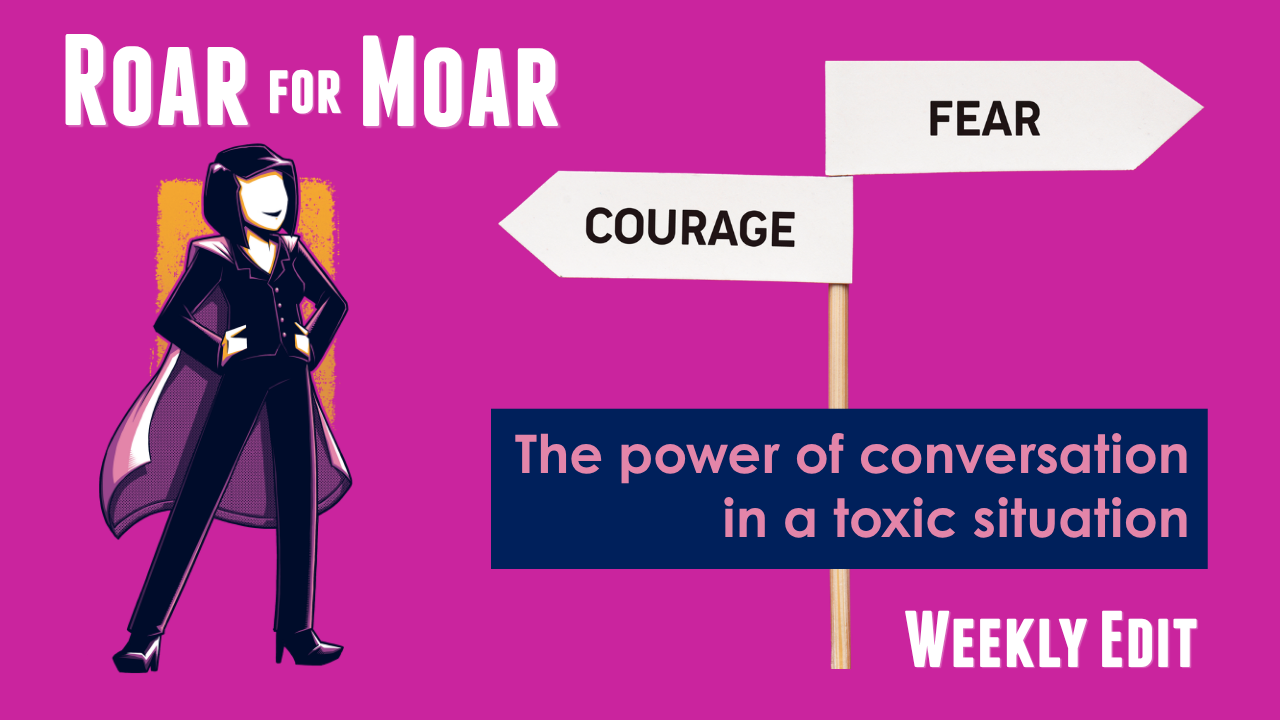
The power of conversation in a toxic situation
Sep 19, 2026I was training the other morning when my personal trainer Katy showed me how to do an exercise for strengthening my lats (my next goal is a wide-grip pull up). As she talked me through it, she said: ‘Marilise, we’re going to train now, we’re not going to perform. It’s easy to perform. To train, is hard.’
Training is slow, it’s controlled, it’s breathing rhythmically. Contracting the muscle deep and holding it there. It’s called time under tension. On the outside it looks like almost nothing is happening. Inside, your muscles are on fire.
I’ve been reflecting on how much of what I’m learning in my physical training also applies to my mental and emotional stamina, especially the way I face courageous conversations inside and out.
Why courageous conversations? And why inside and out?
Courageous conversations are by their nature hard to face. They are high stakes conversations where we’re often dealing with unhealthy, dare I say toxic, behaviour. In this blog I am specifically addressing bullying behaviour, hence spotting the bully inside and out.
Inside and out, because you can’t face the hard conversation (well you can, but it won’t land) with someone else, if you don’t face the courageous conversation with yourself first. It’s why the ROAR! Blueprint and four-step ROAR process exist in the first place. When we speak from a place of purpose, courage and power, it makes magic possible. That is a true, authentic roar. When we speak our truth. And a roar doesn’t have to be loud. As long as you dare to make your voice heard. Even softly at first.
So let’s start with the bully inside.
The bully inside
We all know that voice. Some people call it their inner critic. Some call it their inner villain. Some refer to it as imposter syndrome. I call it my inner bully.
I share in my TEDx that the more I was bullied, the more I bullied myself, because I didn’t believe that I was enough. ‘I’m not OK.’ This prevented me from thinking clearly and seeing the bully for who he was. He wasn’t just a boss demanding high performance, he was demeaning. A bully.
There is disturbingly little research on how to cope with a bully at work. People typically respond in one of three ways: keep quiet, get defensive, or confront the bully.
Two mindsets are prevalent:
- ‘I’m not OK’: I’m uncomfortable dealing with the bully, I don’t have the necessary skills, I feel unable to cope, so I’ll just keep quiet.
- ‘You’re not OK’: you never listen, you’re wrong, you won’t win this one, so I’ll get defensive or confront you.
How do you normally respond?
Every situation offers a choice between acting from ego (fear) or from your authentic self (love).
The ego voice is the loudest in the room. It is a set of beliefs about ourselves and our world that we have absorbed over time, beliefs that limit rather than liberate, and it uses the power of our own minds against us, constantly finding evidence of our inadequacy. An overprotective but deeply misguided guardian who believes that keeping you small keeps you safe.
Mine shaped years of my corporate life. When I was close to failure, it amplified my fear of not being good enough. When I was close to success, it seeded doubt about whether I deserved it. It was the drill sergeant that pushed me to work through bronchitis rather than resting. It masked its fear-based nature behind noble-sounding responsibilities and high standards.
Working harder than everyone else. Never saying no. Fixing problems that were never mine to fix. Workplaces reward that.
When I finally met a bully who brought me to my knees, I tried to please him. I tried to prove my worth. I got defensive and when that didn’t work, kept quiet.
So before you respond, check your thoughts and feel into your body. Is your ego or your authentic self doing the talking?
Your ego asks:
- What can I prove? Am I trying to show someone, or myself, that I’m good enough?
- What can I protect? Am I hiding, out of fear of vulnerability, failure or shame?
- What can I perfect? Am I chasing perfection so that nobody can find fault with me?
- Who can I please? Am I abandoning myself so that someone else will like me?
Your authentic self asks:
- What can I create? What wants to exist here that doesn’t yet?
- What can I contribute? What does this moment actually ask from me?
- How can I connect? What would bring us closer, rather than further apart?
- What can I cultivate? What am I growing, in myself and in other people?
This brings me back to the links between physical training and mental and emotional stamina. When it’s performative, it’s usually to prove something to the outside world. Although performing is the easier option for most, it’s incredibly exhausting because we have to keep up the pretence of being in control. This is a huge contributor to burnout.
Consciously going inside is a lot harder. Breathing and being present and in the moment. Noticing your thoughts and feelings. Regulating your emotions. Responding assertively. On the outside it looks like almost nothing is happening, but that’s the training Katy talks about. The deep inner work which is the hardest work in the world. This can also lead to burnout if you don’t prioritise your daily MEDS (Meditation, Exercise, Diet, Sleep).
Your opportunity now is to stand guard at the door of your mind by becoming super present. To recognise your thoughts and feelings and to interrupt negative patterns by asking better questions. The four Cs: what can I create, contribute or cultivate? How can I connect? And the best question to interrupt a negative thought: how do I know it’s true?
By taming the bully on the inside, you’ll be much better equipped to tame the bully on the outside.
The bully outside
I want to spend a moment acknowledging that talking about bullies feels heavy. It’s a difficult subject to broach. In the middle of writing this blog I had to take a moment away from it.
So I’m back, and we’re going to look at what is actually happening in front of you, and whether the bully in front of you knows what they are doing.
You were in the room and you felt it: you heard the brash tone, you watched the faces drop, your stomach churned.
And then the doubt arrives and quietly overrides the heavy feeling. Surely he didn’t just humiliate me in front of everyone? Surely I’m overreacting? Maybe he is just having a bad day?
We try to excuse the bullying behaviour, especially when the person doing it is more senior than us, and it becomes the way we do things around here. So it’s important to know whether it’s true. Is the person having a bad day, or is this a pattern? You will only know if you face the courageous conversation. That’s the tough truth: by saying nothing, we normalise the behaviour. I’m not saying have courageous conversations at all costs. If you don’t feel safe to do so, then don’t.
Let’s say you do. The accidental bully will be remorseful when you tell them how their behaviour impacted you, and they will rectify it. They’ll make an effort to improve and not repeat the same behaviour. A bully will not. They just cannot see how they are part of the problem. They may well apologise, and then do the same thing again next week. Saying sorry without genuine regret is manipulation.
Bullies demean, destruct and derail.
Note: my bully was a man, but women can be bullies too. My research turned up something that still pains me: when the bully was a woman, the target was usually another woman.
When I was trying to understand my bully’s destructive behaviour, and my own, I started reading about personality disorders, which led me quickly to narcissism. We’re so quick to label someone a narcissist these days that the word has lost most of its meaning. But what I found described my bully almost exactly. A bullying narcissist is someone who:
- Builds themselves up by humiliating other people
- Relies on contempt to make others feel inferior
- Belittles and mocks you
- Becomes threatening when they need something from you
At their most toxic, bullying narcissists make you doubt yourself and your value as a human being.
He’s proving. He’s protecting. He’s perfecting. And where the rest of us try to please, he needs to be pleased. You are his daily narcissistic fix.
Remember this: the bully is always making you feel the way they feel deep down inside, even though they may not know it, or admit it. So if you walk out of a conversation feeling small, ashamed or helpless, those feelings may not have been yours when you walked in. I call it the emotional hot potato pass. The bully will throw the hot potato at you. Block the pass.
So how can you tell that you’re dealing with a bully?
- They’re addicted to attention and feeling special (entitlement)
- They frequently treat people as targets (exploitation)
- They lack empathy, ethics and morals
- They thrive on drama and crisis, and will turn any challenge into some conspiracy against them
- They’re incapable of feeling guilt or remorse (don’t learn from mistakes)
- They’re irresponsible and destructive (disregard the wellbeing of self and others)
- They’ll dismiss people who are not completely loyal (inconsistent, unfair)
- They have a pattern of short-term relationships
- They brag about outsmarting other people
- They live in a fantasy world, marked by delusion (believe their own lies)
One caution before you go looking. Most of us are only watching for the loud one. Covert bullies are less in your face and far more poisonous: snakes in suits, saying what you want to hear and biting you in the back when you least expect it. What you see is not what you get. And if you’re an empath, like me, they can smell you a mile off.
It’s time to courageously face the difficult conversations head-on.
ROAR in action
Before you say anything, set your mindset. Three prompts to walk in with.
I am curious, not furious. Have a learning conversation, not a battle of messages. Go in genuinely curious about the other person’s perspective, and willing to see things their way.
I’m OK, you’re OK. Not ‘I’m not OK’, which keeps you quiet. Not ‘you’re not OK’, which sends you in defensive or fighting. Both of you are OK. Something between you is not.
I think on my feet. Bullies pick their moment, usually when you least expect it, so you will be doing this at speed. Situational awareness and a deep breath buy you the seconds.
Then run the four steps.
Recognise the bullying behaviour. This is where the ten traits earn their keep. You’re not diagnosing anyone, you’re checking what you’re seeing against what you now know. Stay fully present and in your power zone, which means keeping ownership of what you think, feel, say and do. And give the other person the benefit of the doubt, because at this stage you don’t know yet.
Observe and listen attentively. Keep calm and maintain eye contact. Diagnose the real problem rather than the surface of it. And remember: your truth isn’t the truth. Assume you don’t know theirs.
Assert and state the impact. Name the behaviour, not the person. Say what it does. Say what you want instead. ‘When you talk over me in meetings, I stop contributing. I’d like to finish my point.’ One behaviour, one impact, no labels.
Redirect. Move the conversation from me and you, to we. What are we trying to achieve here? How does this get us closer? With an accidental bully, interrupting the pattern like this is very often enough.
The first two steps are all about winning your inner game, your thoughts and feelings. That pause, the deep breath. This is your time under tension. It’s easy to snap back and give a performance. Biting your tongue and staying calm is the hard part. That requires deep inner training, one rep at a time, over and over and over again. Recognise and Observe stop you reacting emotionally. Assert and Redirect, winning your outer game, is how you respond mindfully. This is ROAR in action.
Above all, be safe
We deal with accidental bullies every day, and some days we become them ourselves when we’re stressed, tired or unhappy. This is just life. Never underestimate the value of a face-to-face conversation to improve relationships.
The tough reality is that facing a difficult conversation with a bully very rarely comes without retribution. Believe me, I tried, and I paid the price. So if you’re dealing with an impossible bully, you must protect yourself. Ask for help before it is too late. Know who you can and cannot trust. Take time out, it’s a sign of strength, not weakness. By going on sick leave, you are being kind to yourself. By removing yourself from the toxic situation, you can regain perspective and consider your options. Know your legal rights and document everything. If all else fails, leave.
Next time you face a difficult conversation with yourself or someone else, stop and recognise whether it’s your ego or your authentic self doing the talking. Then run through the ROAR process.
Now is your time to start. Spot the bully inside and out. Then ignite and unleash your authentic roar.
About ROAR! and MOAR!
In ROAR! How to Tame the Bully Inside and Out (December 2019), I tackle the silent damage bullying causes, in the workplace, online, and in everyday life. The book helps readers recognise toxic behaviour, understand the dynamics between bully, victim and culture, and respond with confidence and clarity rather than fear or avoidance. I wrote it after discovering, the hard way, just how common and costly workplace bullying really is.
Get your copy of ROAR! here: https://www.amazon.com/dp/1781334277
In MOAR! How to Play to Win Without Burning Out (February 2026), I turn to burnout, exhaustion and the quiet emptiness so many high achievers feel despite their success. Rather than treating symptoms, MOAR! introduces practical frameworks, including the Wellbeing Trio, the four-step ROAR process and the ROAR for MOAR Hero’s Journey, to help readers lead with authenticity, build thriving cultures and reclaim their energy and voice.
Get your copy of MOAR! here: https://www.amazon.com/dp/1049244788
For South African readers, ROAR! and MOAR! are available in bookstores nationwide, most notably Exclusive Books.
If you would like a signed copy sent directly from me, email marilise@marilise-de-villiers.com (R350 per book, plus R50 postage).
Stay up to date
Get your regular dose of ROAR!
Sign up and receive our email updates and news.
