
Introducing the Empaths and Narcissists series
Nov 03, 2026Courageous conversations about the things that get in the way
I've recently been doing research on empaths and narcissists, and the unhealthy relationship dynamics that form between them. In my book ROAR! How to Tame the Bully Inside and Out, I share how trying to understand my bully's behaviour, and my own, led me to narcissism, and to Dr Craig Malkin's Narcissism Spectrum Scale.
Do you know what was surprising? Dr Malkin defines narcissism as a normal, pervasive human tendency: the drive to feel special. We all have it to a greater or lesser extent.
We have to be careful not to 'diagnose' someone. These days, people are so quick to label someone a 'narcissist' that the term is actually losing its meaning. And it doesn't help, because we focus more and more on our differences. No wonder the world is in such a state.
This is why I love Dr Malkin's Narcissism Spectrum Scale: it helps us see what we all have in common.
So what is the Narcissism Spectrum Scale?
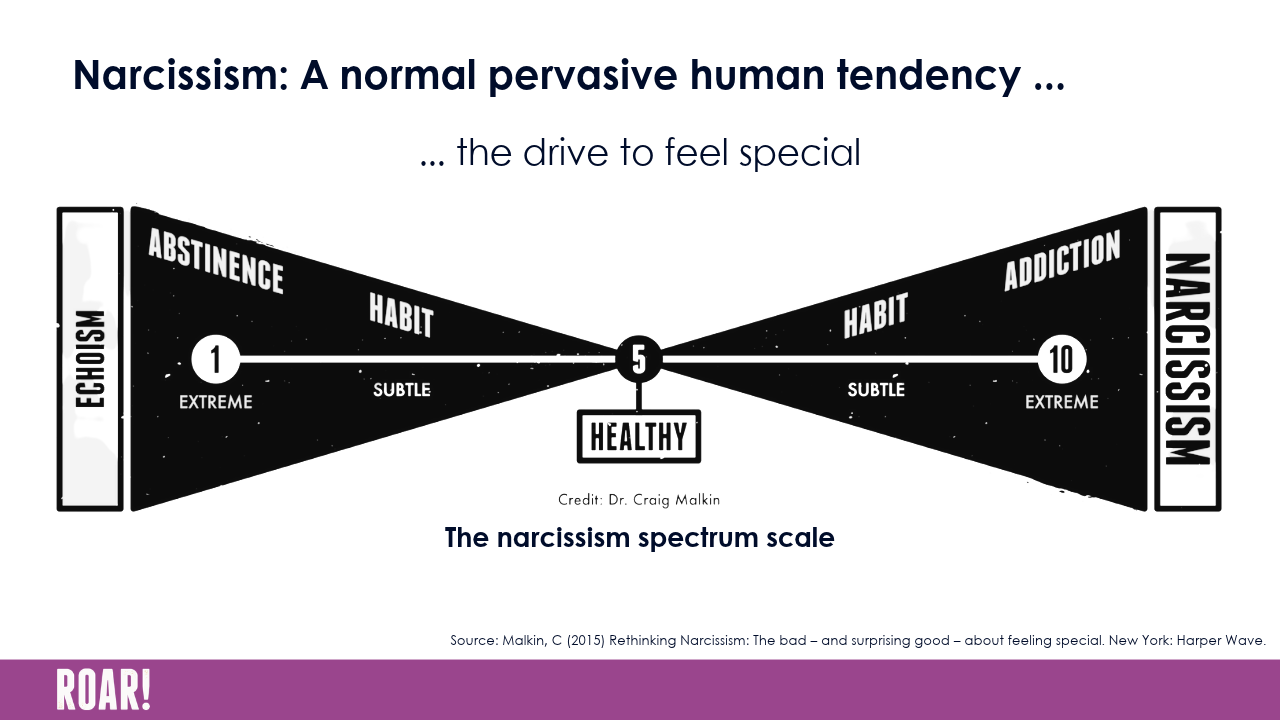
In the picture, you can see a scale from one to ten. Right in the middle, at five, sits healthy narcissism. Here we have a healthy balance: enough self-esteem to set boundaries, and enough empathy to build positive relationships.
As we move to the left, from four down to one, we start to focus on other people's needs at the expense of our own. Dr Malkin calls this echoism, and at its extreme it becomes a fear of feeling special. Echoists are more commonly known as empaths.
There is a Greek myth that shares the story of Echo and Narcissus. You can watch this TED-Ed video to find out more.
As we move to the right, from six up to ten, we start to need to feel special more and more, constantly measuring ourselves against others. This is narcissism, and at its extreme it becomes an addiction to feeling special and a willingness to exploit others to win at all costs.
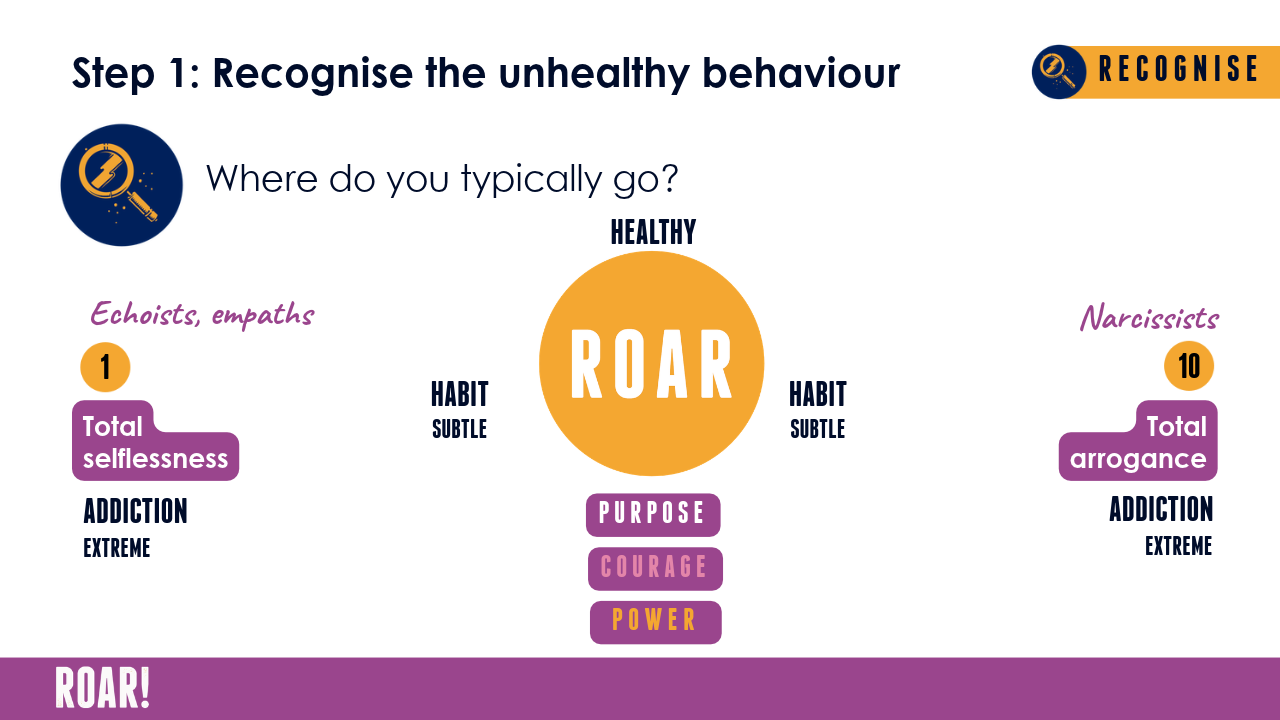
Most of us slide up and down the scale many times a day, depending on our moods and levels of stress. I know I do. And the further we drift towards either end, the more we create unhealthy relationship dynamics. So the question becomes: how do we self-regulate to come back to a healthy five on the scale?
That healthy five is also where my ROAR! Blueprint lives, as a guide to living your best life every day: on purpose, in your power, and with the courage to speak your truth.
Why this conversation matters
The conversation is coming up more and more. In a recent masterclass with a South African bank, people wanted to know how unhealthy relationship dynamics between empaths and narcissists play out, and how we can set healthier boundaries, have more courageous conversations, and better navigate 'toxic' situations. Many wondered if it's even worth a try. I promise you it is, well, in most cases. We'll go deeper on this during the series.
I was also invited to Dr Gustav Gous's Leadership Boardroom in Stellenbosch as an expert speaker on this exact topic. People are engaging with it. They want to know more, and they want to talk about it. So I decided to bring this conversation to you. The ROAR for MOAR podcast and blog will be home to courageous conversations about the things that get in the way, and empaths and narcissists is the first series.
I'll be honest. It's a difficult topic for me to talk about. Those of you who know my story will know why. Every time I broach it, I feel resistance. I feel a charge. But I also see it as an opportunity for me to grow, and to work through some of the healing I still need to do, so I can understand these dynamics fully and keep moving towards that healthy five on the Narcissism Spectrum Scale myself.
Over the coming weeks, I especially want to focus on practical scenarios: those moments when we're facing a difficult situation and it takes courage to have the hard conversation, first with ourselves, and then with others. We'll look at how these dynamics play out, and I'll share practical tips and techniques for facing those conversations to create 'win-win' outcomes and improve our relationships.
Along the way, we'll explore why kind, capable people get drawn into unhealthy dynamics, how they play out at work and at home, and how we find our way back to a healthy five. Next week, we'll start with the common traits of empaths and narcissists, and how to spot unhealthy behaviours.
I'd love you to come on this journey with me. And if you're in the middle of a relationship like this right now, please be kind to yourself. If it feels too heavy, pause and ask for help.
P.S. If there is anything in particular you'd like me to address, or any questions you have on this topic, please feel free to send me a personal message or comment below.
Stay up to date
Get your regular dose of ROAR!
Sign up and receive our email updates and news.
