
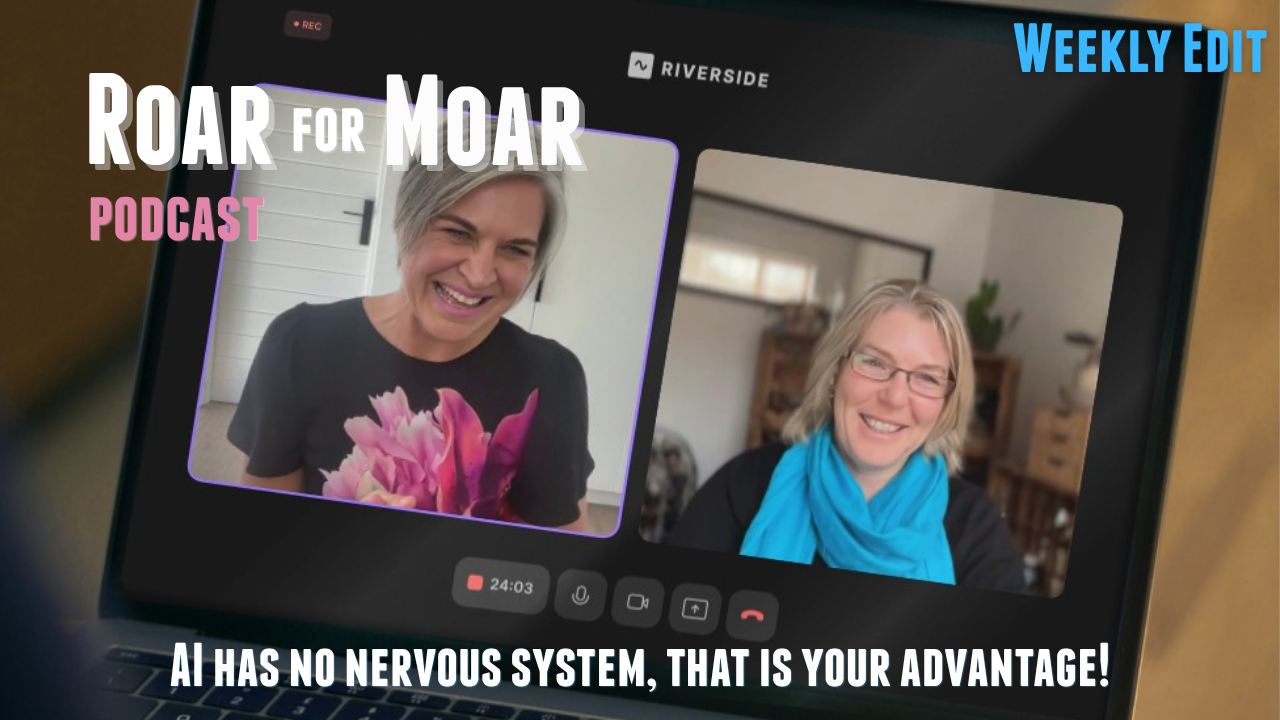
AI doesn’t have a nervous system. That’s your advantage.
Jul 08, 2026A ROAR for MOAR conversation with Joanne Perold on capacity, presence and the parts of us that react before we choose
A few weeks ago, I invited Joanne Perold as my guest on the ROAR for MOAR podcast. We explored one of the most important questions in leadership right now: what if the most important leadership skill is not a skill per se, but capacity?
Jo is the director, head coach and trainer at Fathom, which she founded in 2021. She has spent over two decades in leadership development, grounded in Virginia Satir’s growth model, and what she keeps finding, across the leaders she coaches and interviews, is the same gap: complexity increases exponentially, but the capacity to deal with it doesn’t.
Near the end of the conversation, we turned our attention to AI, and what makes us irreplaceably human. Jo said it plainly: ‘AI doesn’t have a nervous system.’ That line stayed with me, so much so that I decided to make it the title of this episode: AI doesn’t have a nervous system. That’s your advantage.
Until it isn’t. A week after my chat with Jo I was living this reality in real time. I was confronted with another tough truth. What if my nervous system is also my disadvantage? Let me explain…
With Hyrox just over a month away, I’d started ramping up my training. I began the week on the back foot, behind on my training schedule. So, I did what I do best – hit the gym hard on Monday with a gruelling HIIT session on my own. Tuesday left only 45 minutes between meetings, so I went out for a 30-minute sprint and walk, lamp post to lamp post.
On Wednesday, when Katy, my personal trainer, asked what I had done so far this week, I explained. She gave me her usual calm, intense look and said quietly: ‘So you sprinted 15 minutes and walked 15 minutes.’ Yes, I said, confidently. She paused. ‘Marilise, 5 minutes of sprinting would have been more than enough. This is a new exercise we’re introducing. You cannot go from zero to hero. The deadline becomes destructive if you don’t control your system.’
My old conditioning of ‘all or nothing’ meant I had started the week with guns blazing. It is a great way to open your ‘Warrior’ life force energy to kick off deadlines or personal goals, but going all-out right out of the gate can lead to burnout by Wednesday. The irony was not lost on me.
Why is it so much easier to distract ourselves into destruction, than it is to pause and recognise the old story that is no longer serving us?
That question sat at the heart of my conversation with Jo.
Jo described capacity as that feeling of space. When something happens and you do not react instantly, but you have room to think, to pause, to understand what is actually going on. And then you choose your response. It is a conscious choice, not an automatic reaction.
So what happens when the space collapses?
Your inner child grabs the wheel
An old part of you takes over, reacting to a situation from decades ago rather than the one in front of you. ‘The person that’s in charge of us is actually a five-year-old,’ Jo told me, ‘…and I don’t know about you, but I prefer it when my not-five-year-old is in charge.’
She described a part of her own that shows up when she does not feel heard: loud, belligerent, getting louder the less it is heard. Rather than fighting it, she has learned to notice it coming, name it, and meet it with something closer to a hug than a battle.
This is the work Virginia Satir left behind: not just naming our parts, but reconnecting with what she called a self-esteem maintenance toolkit, the resources Satir believed every human is born with and quietly loses touch with. A courage stick, for the moments that ask you to be brave. A detective's hat, for curiosity. A wisdom box, because we already carry more wisdom than we credit ourselves with. A magic wand, for possibility. And the heart, added later by Jean McClendon, because Virginia, in Jo's words, 'did everything with her heart,' and somehow it had been left out.'
Jo put it plainly: the more noise there is, the more you need to slow down. If you cannot meditate for five minutes, you should probably do it for half an hour. The toolkit is there. The question is whether you are present enough to reach for it.
It is also why I created the four-step ROAR process, to help you stand guard at the door of your mind, and to go from reacting emotionally to responding mindfully. Here is how…
ROAR in action
‘Between stimulus and response there is a space. In that space is our power to choose our response. In our response lies our growth and our freedom.’
— Viktor Frankl
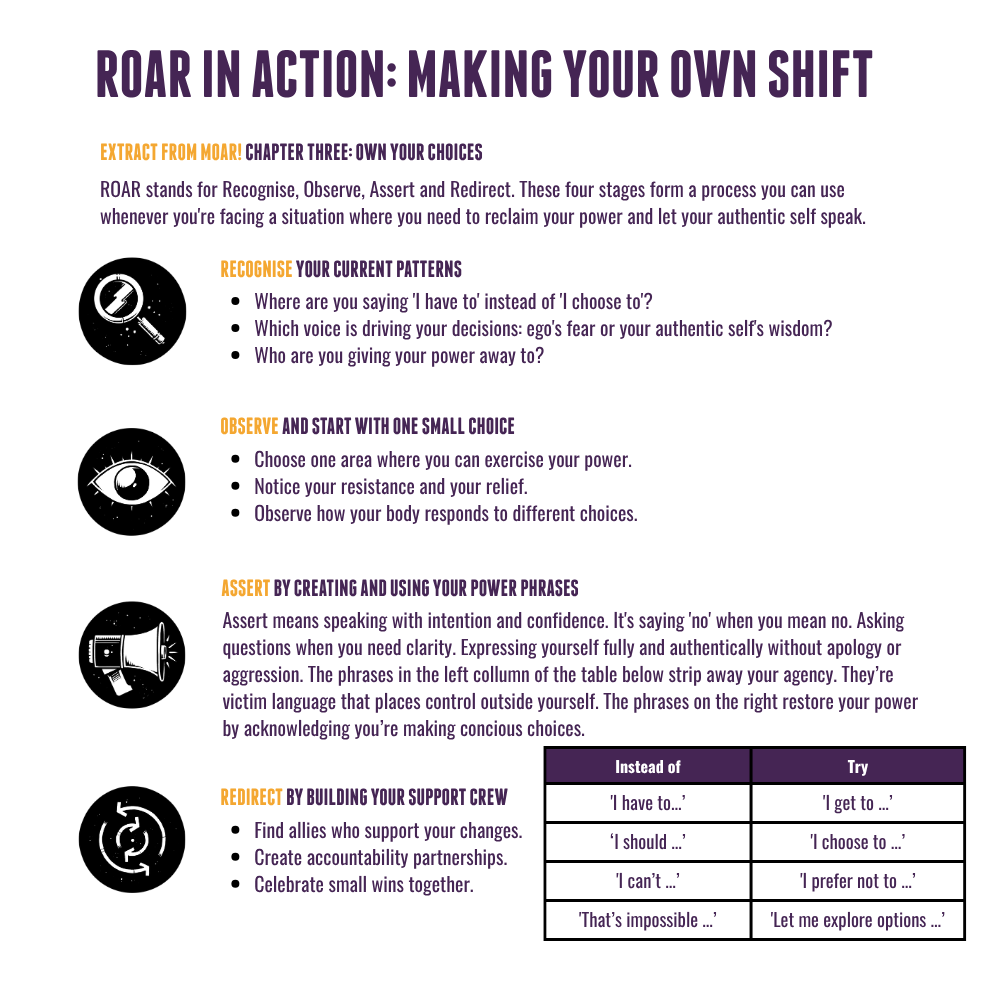
ROAR in Action: Making your own shift
Extract from MOAR! How to Play to Win Without Burning Out, Chapter Three, Own your Choices.
Today’s greatest gift?
Being fully present.
My second burnout, after moving back to South Africa, taught me that I was still playing by an old playbook: hustle, hustle, hustle … do more, do more, do more, … I had to find a new way of being. That new way of being became ‘I am present, I am peaceful, I am powerful.’
It is a moment-by-moment practice for staying fully present and regulating my central nervous system. The moment things feel too tough, I stop and check in with myself.
Creating the capacity to be fully present is not something you do once and master. It is a choice you make over, and over, and over again. It is like building a muscle: you have to keep showing up and put in the reps, over, and over, and over again.
Jo reiterated that presence is not just what you give others, it is what you build for yourself first. You cannot give what you do not have, in other words, you cannot offer someone your full attention if you are not present to yourself. We all have thousands of tabs open, not just on our laptops but in our heads as well.
That is why I am so passionate about doing the inner work first. Slow down enough to be fully present with your thoughts, feelings, words and actions. It is the hardest work in the world.
The person in front of you can feel the difference. They cannot always name it, but they know when you have actually arrived. Show up for them. Show up as your authentic self.
Listen to the full conversation with Joanne Perold on the ROAR for MOAR podcast here: https://www.marilise-de-villiers.com/podcasts/roar-for-moar-marilise-de-villiers/episodes/2149220365.
If this is your first time joining us, subscribe so the next episode lands straight in your feed.
Stay up to date
Get your regular dose of ROAR!
Sign up and receive our email updates and news.
