
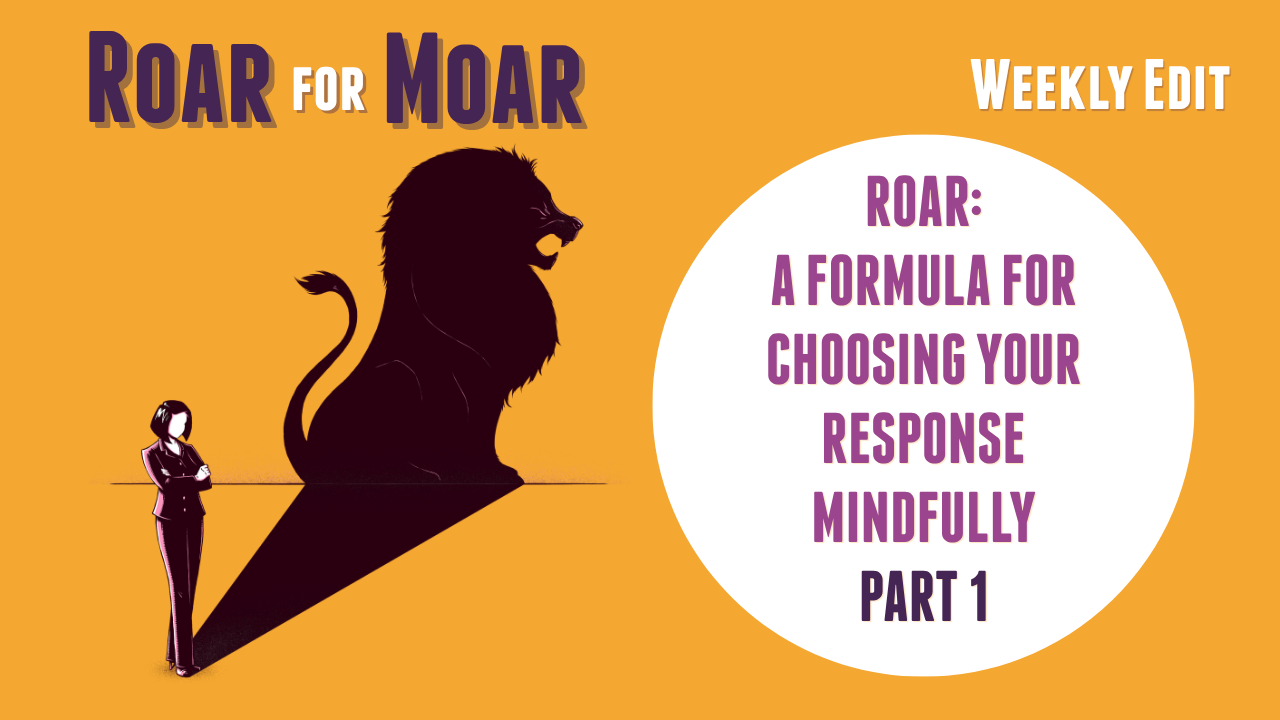
ROAR: a formula for choosing your response mindfully | Part 1 of 2
Apr 21, 2026“Between stimulus and response there is a space. In that space is our power to choose our response. In our response lies our growth and our freedom.”
— Viktor Frankl
The power of the mind
Have you noticed that a single choice, big or small, can alter the entire course of your life? The moment you choose to speak up rather than stay silent. The decision to close your laptop at 6pm. The quiet commitment to yourself that ‘I’ve done enough’, or even better still, ‘I am enough’.
Life presents us with moments that are beautiful as well as brutal; circumstances we didn’t choose, challenges we didn’t expect, and people and systems that affect us without our consent. But within this universal experience lies an extraordinary possibility: the freedom to choose our response and to own our path forward rather than simply reacting to what happens to us.
As Dr Edith Eger writes in The Choice: suffering from victimisation is universal, but victimhood is optional. Victimhood comes from the inside. We become victims not by what happens to us but by choosing to hold on to our victimisation.
Here’s where the path forks: when the storm hits, do you ask ‘Why me?’ or ‘What now?’ The first question leads to a maze with no exit. The second opens a door.
This is not about bypassing pain or pretending vulnerability does not exist. It is about what you choose to do with what happens to you.
This is the space Frankl wrote about. And it begins in the mind.
What mindfulness is
Mindfulness is how we learn to enter the space between stimulus and response.
Jon Kabat-Zinn is the scientist who pioneered mindfulness-based stress reduction (MBSR) in the 1970s at the University of Massachusetts Medical School. His work brought mindfulness meditation into mainstream medicine, psychology and organisations, and it has since transformed hospitals, schools and workplaces globally.
Kabat-Zinn defines mindfulness as ‘paying attention, on purpose, in the present moment, non-judgementally’. In short: mindfulness is embodied awareness.
Most of us, under pressure, collapse the space between stimulus and response entirely. The stimulus arrives and the reaction follows almost instantaneously. No gap, no choice, no freedom. Mindfulness is the practice of restoring that gap.
I learned this the hard way.
My ROAR! origin story
In my TEDx talk I describe the day my boss demoted me in front of my entire team; publicly, without warning. How I sat there frozen, paralysed with shame. How I saw myself in the bathroom mirror afterwards, and hearing a quiet voice inside me say: enough is enough. How I quit the next day.
What led me to that moment stretches far further back. At 20, I found myself in rehab being treated for bulimia, an eating disorder. It was there, in the stillness that rehab forced upon me, that I first encountered mindfulness meditation, and although it made an impression, it did not become a daily practice. Life got in the way. In my thirties, work addiction and burnout followed. My exhaustion was not just physical; it was soul deep. It would take a bully, and four years of trying to please him and everyone else except myself, to finally bring me to my knees.
Each experience was a reckoning. Each one pointed me toward the same understanding: I had been reacting emotionally, not responding mindfully.
The reckoning with a bully led to my first book, ROAR! How to Tame the Bully Inside and Out, and the four-step ROAR process. Here is what my research for the book revealed about how people typically react when facing a bully:
We keep quiet. When someone in power is making your life miserable, silence can feel like the only safe option. But it is not safety. It is slow surrender, and self-betrayal. Every time the bully gets away with it, the behaviour becomes more normalised. And quietly, we lose respect for ourselves.
We get defensive. It feels natural to want to protect ourselves, to be seen accurately, to push back against unfair treatment. But getting defensive hands the bully exactly what they want. Getting defensive was my primary tactic, and I played right into his hands every single time.
We fight back. We confront, we challenge, we write the letter. For a moment it feels like action. But less than 5% of people in my research reported improved behaviour from their bully as a result of directly confronting them. I know this because I wrote the letter. I spent two hours being subjected to insult after insult for my trouble.
Three emotional reactions. Three dead ends. Not because the intention is wrong, it is the ego trying to protect us.
Which reaction can you relate to?
I had to learn to go from reacting emotionally to responding mindfully so I created the four-step ROAR process which sits at the heart of the ROAR! Blueprint.
ROAR! Blueprint and four-step ROAR process
The ROAR! Blueprint is how I aspire to live my best life every day: on purpose, in my power and with the courage to speak my truth. It consists of four elements: Authentic Purpose, Inner Game, Outer Game and Authentic ROAR.
ROAR is an acronym for four stages that help you move from reaction to creation, from ego patterns to authentic choices. It stands for Recognise, Observe, Assert, Redirect. It is a process you can use every moment of every day, and especially when you are facing a situation where you need to reclaim your power and let your authentic self speak.
In short: ROAR is a mindful response process. First, you win your inner game and then you win your outer game as follows:
- Win the inner game (thoughts and feelings) — you Recognise and Observe.
- Win the outer game (words and actions) — you Assert and Redirect.
Let’s step through the ROAR process together.
ROAR in action
I’d like to invite you to think of a conversation you are avoiding.
Let’s say you decide to face the conversation: what do you want to get out of it? What would be the best outcome for both parties?
Now, picture the other person. Pretend you’re going into the conversation.
Have an ‘I’m OK, you’re OK’ mindset. This means having positive regard for yourself and the other person: ‘I’m OK, you’re OK.’ Now apply the four steps.
- Recognise. Notice what the other person is saying and doing. Recognise your own thoughts and feelings. Regulate yourself. Stay calm.
- Observe. See the other person; really see them. Listen attentively. Stay present. Have a learning mindset: ‘Be curious, not furious.’
- Assert. Say what you think and how you feel, focusing on the impact of their behaviour, not their intention. Or ask the appropriate question. Stay in your power zone.
Repeat 1,2, and 3 as many times as necessary.
4. Redirect. When you are ready, redirect the conversation towards win-win outcomes.
ROAR does not give you the power to respond mindfully. That power already lives inside you. What it gives you is the process to access it, between stimulus and response, in the moments that matter most.
You are so much stronger than you give yourself credit for. YOU are your superpower.
In Part 2: ROAR for cyber mindfulness, we explore how ROAR applies to cybersecurity, a world I have been deeply immersed in for nearly 15 years, and where the cost of one wrong decision can be devastating.
Stay up to date
Get your regular dose of ROAR!
Sign up and receive our email updates and news.
